Correlation between body mass index and blood pressure among first-year undergraduate medical students in Punjab: A cross-sectional study
DOI:
https://doi.org/10.23921/amp.2026v9i1.00079Keywords:
Blood pressure, Body Mass Index, Medical students, ObesityAbstract
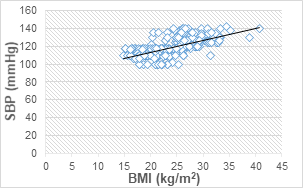
Obesity and hypertension are emerging public health concerns among young adults. Body mass index (BMI) is an important indicator of obesity and is associated with elevated blood pressure. Medical students are exposed to lifestyle risk factors such as academic stress, irregular dietary habits, physical inactivity and altered sleep patterns, which may influence both BMI and blood pressure. The study was conducted to find the correlation between BMI and blood pressure among first-year undergraduate medical students. This cross-sectional study was conducted among 300 first-year undergraduate students enrolled in MBBS and Allied Healthcare programs at Sri Guru Ram Das Institute of Medical Sciences and Research, Amritsar. Height, weight and blood pressure was recorded using standard methods and BMI was calculated. The mean BMI was 23.46 ± 4.55 kg/m2. The mean systolic blood pressure (SBP) and diastolic blood pressure (DBP) were 118.19 ± 9.47 mmHg and 75.99 ± 9.60 mmHg, respectively. Most participants had normal blood pressure (64.7%) while 32.7% were pre-hypertensive, and 2.7% (8 participants) had stage 1 hypertension (although participants with previously diagnosed hypertension were excluded at enrolment). Higher BMI was associated with increased systolic and diastolic blood pressure. A statistically significant moderate positive correlation was observed between BMI and SBP (rho = 0.674, p<0.001) and between BMI and DBP (rho = 0.681, p<0.001). The present study demonstrated a significant moderate positive correlation between BMI and blood pressure among first-year medical students. Early lifestyle modifications and regular health screening may help to reduce the future cardiovascular risk.
Downloads
References
Gundogdu Z. Relationship between BMI and blood pressure in girls and boys. Public Health Nutr. 2008;11(10):1085-1088.
Lindholt JS, Søgaard R. Population screening and intervention for vascular disease in Danish men (VIVA): a randomised controlled trial. Lancet. 2017;390(10109):2256-2265.
Sharda K, Saxena P, Yadav SK, Sharma A, Gurjar M, Dayama N, Kashnia R. To estimate the prevalence of obesity and high blood pressure among undergraduate students at a university medical institution in North India. J Assoc Physicians India. 2023;71(11):30-35.
Gopalakrishnan S, Ganeshkumar P, Prakash MV, Christopher, Amalraj V. Prevalence of overweight/obesity among the medical students, Malaysia. Med J Malaysia. 2012;67(4):442-444.
Waseem SM, Bano R. Blood pressure measurement in overweight, underweight and normal BMI undergraduate students of a private medical college: Correlation of BMI with blood pressure. Int J Res Med Sci. 2017;5 (7):2921-2925.
NCD Risk Factor Collaboration (NCD-RisC). Worldwide trends in hypertension prevalence and progress in treatment and control from 1990 to 2019: a pooled analysis of 1201 population-representative studies with 104 million participants. Lancet. 2021;398(10304):957-980.
Rahmouni K, Correia ML, Haynes WG, Mark AL. Obesity-associated hypertension: new insights into mechanisms. Hypertension. 2005;45(1):9-14.
Katzmarzyk PT, Srinivasan SR, Chen W, Malina RM, Bouchard C, Berenson GS. Body mass index, waist circumference, and clustering of cardiovascular disease risk factors in a biracial sample of children and adolescents. Pediatrics. 2004;114(2):e198-e205.
Yang L, Sun J, Zhao M, Liang Y, Bovet P, Xi B. Elevated blood pressure in childhood and hypertension risk in adulthood: a systematic review and meta-analysis. J Hypertens. 2020;38(12):2346-2355.
Hall JE, do Carmo JM, da Silva AA, Wang Z, Hall ME. Obesity-induced hypertension: interaction of neurohumoral and renal mechanisms. Circ Res. 2015;116(6):991-1006.
Nigam M, Verma P, Gupta P. IJCM_179A: Prevalence of overweight and obesity among M.B.B.S students. Indian J Community Med. 2024;49(Suppl 1):S52.
Shafiee A, Nakhaee Z, Bahri RA, Amini MJ, Salehi A, Jafarabady K, Seighali N, Rashidian P, Fathi H, Esmaeilpur Abianeh F, Omran SP, Bakhtiyari M, Alirezaei A. Global prevalence of obesity and overweight among medical students: a systematic review and meta-analysis. BMC Public Health. 2024;24(1):1673.
Ackuaku-Dogbe EM, Abaidoo B. Breakfast eating habits among medical students. Ghana Med J. 2014;48(2):66-70.
El-Gilany A, AbdelHady D, Damanawy R. Consumption and knowledge of fast/junk foods among medical students, Mansoura university, Egypt. TAF Prev Med Bull. 2016;15(5):440-445.
Pramod P, Siji VS, Amma KR, Mendz AM, Prajwal, Vaishnavi, Ruksana. Physical activity pattern among undergraduate medical students in a rural medical college in Southkerala: A cross-sectional study. Indian Journal of Public Health Research and Development. 2024;15(1):254-258.
Chattopadhyay A, Taraphdar P, Sahu BK, Maulik S, Ghosh R, Sinha A, Biswas M. A study on prevalence of hypertension and its related risk factors among undergraduate medical students in Kolkata. IOSR J Dent Med Sci. 2014;13(11):1-7.
Khan ZA, Qureshi U, Khan T, Goel S. Change in the prevalence of prehypertension and hypertension among young Indians aged 15-24 years between 2015-16 and 2019-21: Insights from nationally representative surveys. PLoS One. 2025;20(4):e0319274.
Hazari MA, Arifuddin MS, Hussain HZ, Fatima F, Kahkashan N. Central blood pressure parameters in young adults with and without parental history of hypertension. Ann Med Physiol. 2017;1(1):16-21.
Abdulghani HM, AlKanhal AA, Mahmoud ES, Ponnamperuma GG, Alfaris EA. Stress and its effects on medical students: a cross-sectional study at a college of medicine in Saudi Arabia. J Health Popul Nutr. 2011;29(5):516-522.
da Silva AA, do Carmo J, Dubinion J, Hall JE. The role of the sympathetic nervous system in obesity-related hypertension. Curr Hypertens Rep. 2009;11(3):206-211.
Brosolo G, Da Porto A, Bulfone L, Vacca A, Bertin N, Scandolin L, Catena C, Sechi LA. Insulin resistance and high blood pressure: Mechanistic insight on the role of the kidney. Biomedicines. 2022;10(10):2374.
Published
Issue
Section
Categories
License
Copyright (c) 2026 Quench Academy of Medical Education and Research (QAMER)

This work is licensed under a Creative Commons Attribution 4.0 International License.
The authors warrants and represents that the submitted MANUSCRIPT is an original work and has not been published before in any form, and that it does not infringe upon any copyright or other right(s), that it does not contain infringing, libelous, obscene or other unlawful matter, that he/she is the sole and exclusive owner of the rights here-in conveyed to the Publisher, and that he/she has obtained the customary permission from the copyright owner or his legal representative whenever a text/passage from copyrighted material is quoted or a table or illustration from such material is used. The Author(s) will indemnify the Publisher for, and hold the Publisher harmless from any loss, expense or damage occasioned by any claim or suit by a third party for copyright infringement or arising out of any breach of the foregoing warranties as a result of publication of the Article. The Article shall be delivered to the Publisher free of copyright charges. In the event that the Article is not accepted and published by Publisher, this agreement becomes null and void.
Sherpa/Romeo publisher policy can be viewed at Annals of Medical Physiology - Sherpa/Romeo Policy